What are the main dealer reinsurance structures?
The common structures, from simplest to most involved, are: Retro (share in results with no separate company), NCFC (a pooled foreign company you don't control), CFC (a foreign company you control, often the landing spot for dealers with steady volume), Super CFC (a higher-capacity CFC variant using retail cost accounting), and DOWC (a U.S. warranty company you own outright). They differ in ownership, control, capital, risk, reporting, tax complexity, and the volume they fit. No structure is universally best or automatically qualifies for any tax treatment — the right choice depends on a dealer's facts and qualified advice.
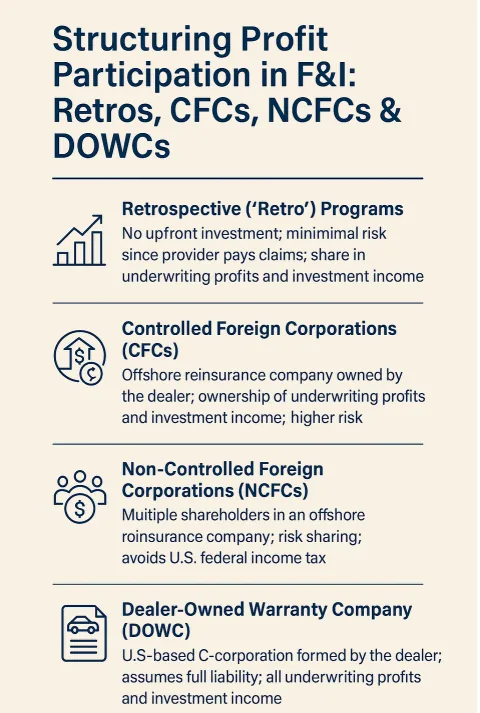
Dealer reinsurance is not one thing — it is a spectrum of structures that trade capital and complexity for control and economics. Retro is the low-friction on-ramp; a CFC is where many dealers with consistent volume land; a Super CFC adds capacity; a DOWC offers the most control and margin at the highest cost and compliance; an NCFC pools dealers to lower individual burden. Matching the structure to a dealership's volume, capital, goals, and risk tolerance — with qualified tax and legal advice — matters far more than the label.
- The structures form a ladder: Retro → NCFC / CFC → Super CFC → DOWC, roughly increasing in control, capital, and complexity.
- Offshore structures (CFC, Super CFC, NCFC) may involve elections such as §953(d) and §831(b); a DOWC is domestic and generally taxed as a U.S. corporation.
- No structure automatically qualifies for a given tax election or result — qualification is fact-specific.
- Control and margin rise with a DOWC; capital and compliance rise with it too.
- The right structure depends on volume, capital, goals, and advice — not on which one is “best.”
Why Structure Choice Matters
What begins as a profit center in the finance office can become a long-term wealth engine when a dealer takes ownership of the underwriting profit on F&I products. But how that ownership is structured shapes everything that follows: how much capital is required, who controls claims and investments, how profit is taxed, and when it can be accessed. This guide compares the common structures so you can see where each fits. For the broader picture of how reinsurance works, start with The Complete Guide to Dealer Reinsurance; for the first steps of setting one up, see How to Start a Dealer Reinsurance Program.
The Structures at a Glance
| Structure | Ownership & domicile | Control | Capital | Tax complexity | Typically fits |
|---|---|---|---|---|---|
| Retro | No separate entity | Low | Minimal | Low | Building toward volume; testing participation |
| NCFC | Foreign; ≤50% dealer-owned (pooled) | Shared | Low–moderate | Moderate | Smaller stores / groups wanting ownership with less capital |
| CFC | Foreign; >50% dealer-owned | High | Moderate | Higher (possible §953(d)/§831(b) elections) | Consistent volume; a common landing spot |
| Super CFC | Foreign; dealer-owned | High | Moderate–high | Higher (retail cost accounting) | Higher volume wanting more capacity than a CFC |
| DOWC | Domestic (U.S.); dealer-owned | Highest | Highest | U.S. C-corp treatment | High-volume dealers & groups wanting maximum control |
“Control,” “capital,” and “tax complexity” are relative, not absolute. Actual requirements and tax treatment depend on ownership, domicile, program design, premium volume, and applicable law — and on the advice of qualified tax and legal professionals.
Retro Profit-Sharing Programs
A retrospective (retro) program lets a dealer share in the underwriting results of their book of F&I business without forming a separate company. The dealer receives a retrospective payment based on actual claims experience. Because there is no entity to capitalize, it requires little or no upfront investment, which makes it a common first step into profit participation. The tradeoff: it generally offers less upside and fewer tax-planning options than owning a captive, and the dealer has limited control over investments and claims philosophy. Retro is often a stepping stone dealers use while building toward the volume that supports a standalone structure.
Non-Controlled Foreign Corporation (NCFC)
An NCFC is a foreign reinsurance company in which U.S. shareholders own 50% or less, so it is generally not a “controlled” foreign corporation and may be subject to different tax rules than a CFC. Production is typically pooled across multiple dealers, which spreads risk (aiding risk distribution) and can reduce individual capital and administrative burden. Pooling can also ease some of the constraints a single-owner CFC faces. The tradeoff is control: a dealer gives up some individual authority in exchange for scale and lower burden. NCFCs are often considered by smaller or single-point stores wanting ownership without full capitalization, and by groups seeking scale.
Controlled Foreign Corporation (CFC)
A CFC is a foreign corporation more than 50% owned by U.S. shareholders — here, a reinsurance company the dealer forms offshore (commonly in jurisdictions such as Turks & Caicos or Nevis). It captures underwriting profit and investment income under the dealer's control. Depending on the facts, a CFC may elect under §953(d) to be taxed as a U.S. company and, if it separately qualifies, make an §831(b) election — but neither election is automatic, and §831(b) carries an annual premium limit and real qualification requirements. For many dealers with consistent volume, a CFC is the natural landing spot: meaningful control and economics without the full capital and compliance of a domestic warranty company.
Super CFC
A Super CFC is an enhanced CFC-style structure that uses retail cost accounting rather than net cost accounting. That method is intended to generate larger deductions and net operating losses (NOLs) in the early years and to allow more premium to be ceded into the company than a standard CFC — potentially supporting higher reserves, more investment capacity, and greater equity growth. Those benefits are fact-specific and depend on the structure and applicable law. A Super CFC is generally aimed at higher-volume operations that want more capacity than a standard CFC without taking on the full infrastructure of a DOWC. It sits between a CFC and a DOWC on the control/complexity ladder.
Dealer-Owned Warranty Company (DOWC)
A DOWC is a domestic (U.S.) company the dealer owns outright that issues its own F&I contracts as the obligor — meaning the dealer's company is legally responsible for claims and keeps not just the underwriting profit but also the retail margin. It offers the most control and brand ownership, and it is generally taxed as a regular U.S. C corporation rather than under §831(b). The tradeoff is cost and complexity: a DOWC requires the most capital, oversight, licensing, and compliance infrastructure. It is best suited to high-volume dealers and dealer groups with the production and appetite to run what is, in effect, their own warranty company.
Which Structure Fits? A Simple Framework
This is orientation, not a recommendation. The right structure depends on your volume, capital, product mix, loss experience, goals, domicile options, and the guidance of qualified tax and legal advisors.
A single-point store writing a steady book might start with a retro to participate now, move to a CFC as volume becomes consistent, and — only if it grows into a high-volume group with the appetite for the complexity — eventually consider a DOWC. This progression is illustrative; the right path and timing depend entirely on the dealer's facts and qualified advice, and outcomes are not guaranteed.
Common Mistakes When Choosing a Structure
- Choosing a structure by label or prestige rather than fit for the dealership's volume and goals.
- Comparing structures using unequal assumptions (different volumes, loss ratios, or fees).
- Assuming any structure automatically qualifies for §831(b) or a particular tax result.
- Underestimating the capital and compliance a DOWC (or Super CFC) requires.
- Overlooking control tradeoffs in a pooled NCFC.
- Ignoring fees, claims philosophy, and administrator quality — which affect every structure's results.
Questions to Ask Before Choosing a Structure
- What volume and product mix do I actually have, and is it consistent?
- Who owns and controls the company, and who directs claims and investments?
- What capital and ongoing compliance does this structure require?
- How is this structure taxed for my facts — and what elections, if any, is it relying on?
- What are all the fees, at every layer, and how do they compare across structures?
- How and when can profit be accessed, and what are the exit and provider-replacement terms?
- Can I change structures later as the dealership grows?
When to Involve Qualified Advisors
Structure selection touches insurance, tax, law, and accounting simultaneously. This guide is educational and is not tax, legal, insurance, or accounting advice. Before choosing a structure, forming an entity, or relying on any tax election, involve qualified professionals — the outcome depends on ownership, domicile, structure, premium volume, claims, expenses, reserve development, administration, investments, contract design, applicable law, taxpayer facts, and time. On §831(b) specifically, the IRS actively scrutinizes abusive “micro-captive” arrangements; see the IRS guidance on abusive micro-captive transactions.