Can a powersports dealership use reinsurance or profit participation?
Often, yes — eligible powersports dealers may participate in the underwriting results of products they sell, such as service contracts and other protection products, through a dealer-related reinsurance structure. But feasibility isn't automatic: it depends on unit volume, product mix, claims performance, the chosen structure, the administrator and carrier, fees, and the owner's long-term objectives. Powersports programs also differ from automotive ones in seasonality, product mix, and unit values. This is educational, not tax, legal, or insurance advice, and no result is guaranteed.
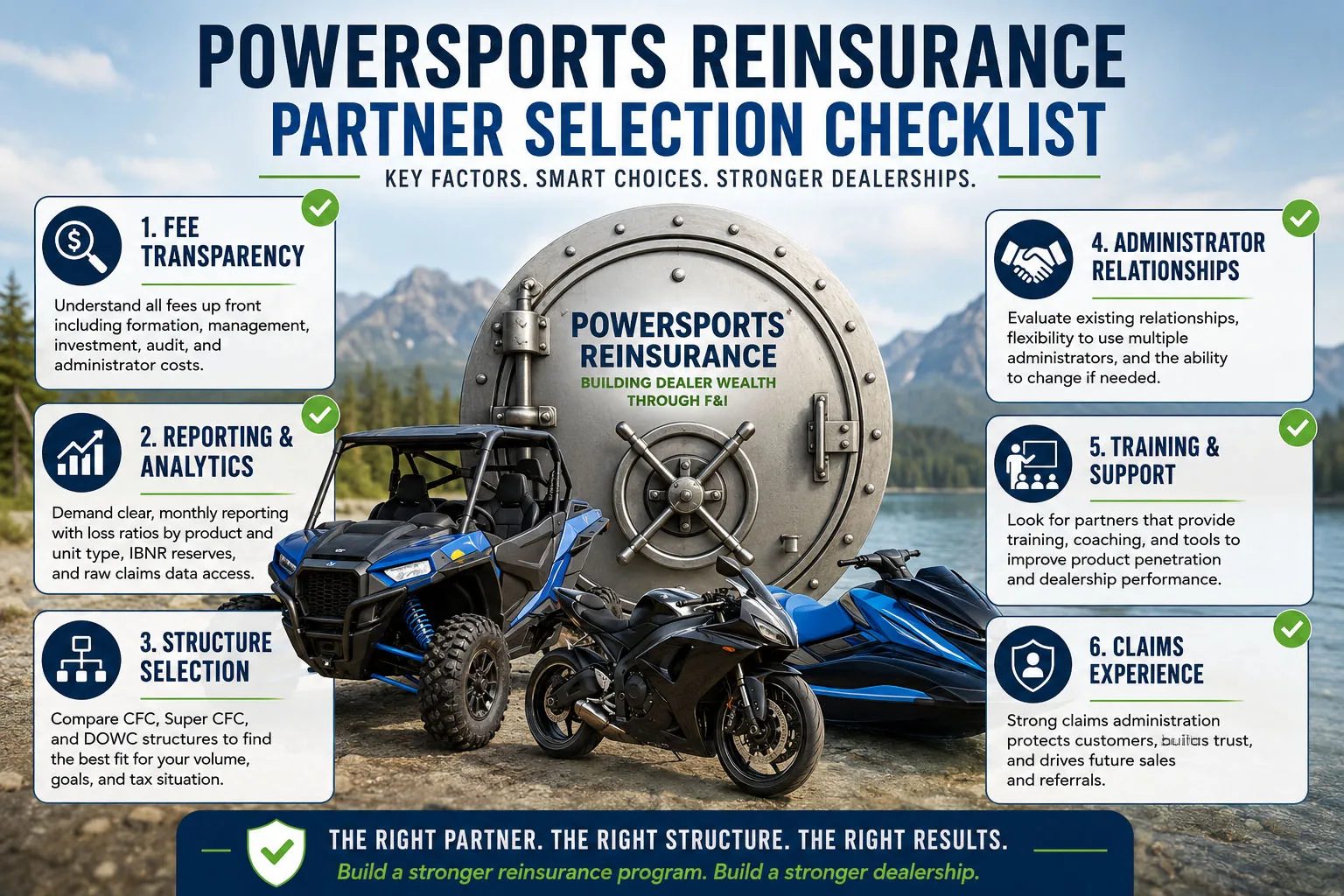
Most reinsurance material is written for franchised automotive dealers and doesn't address what's different about powersports. This guide is for owners of motorcycle, ATV, UTV/side-by-side, personal-watercraft, marine, and RV dealerships weighing whether profit participation fits their business. It covers what powersports dealer reinsurance is, which segments and products may be included, how the money and claims flow, why powersports claims and seasonality can differ, the structures involved, how to evaluate an administrator and carrier, the risks, and a program-fit framework. For the broad definition and the full mechanics, it links to The Complete Guide and How Dealer Reinsurance Works rather than repeating them.
- Powersports dealers may participate in eligible product economics — but eligibility and fit vary by product, administrator, carrier, state, structure, and volume.
- Seasonality, product mix, and lower average contract values make powersports economics different from automotive.
- Claims can differ (off-road use, modifications, hours vs. miles) — different, not inherently worse, and dependent on contract design and administration.
- Lower monthly unit volume does not automatically make reinsurance unsuitable; a strong season doesn't establish program maturity.
- No single structure, administrator, or product is universally right — evaluate against the dealership's own facts and objectives.
What Powersports Dealer Reinsurance Is
In a powersports reinsurance program, the dealership sells eligible protection products; a portion of the economics may be ceded into a dealer-related reinsurance structure; claims and expenses are paid from the funds held; and any remaining underwriting result plus investment income may accumulate over years. Results are not guaranteed — they depend on the factors this article walks through. The broad definition lives in The Complete Guide to Dealer Reinsurance; the point here is that the same core idea applies to powersports, with segment-specific wrinkles.
Which Dealerships May Be Included
Several kinds of recreational dealerships may participate, though eligibility can vary by product, administrator, carrier, state, structure, volume, and claims experience — and no two segments run identical programs:
| Segment | Common products | Operational considerations | A question to ask |
|---|---|---|---|
| Motorcycle | Service contracts, GAP, tire & wheel | Seasonal, mileage-based use | Which makes/models are eligible? |
| ATV | Service contracts, ancillary | Off-road use, engine-hours | How is off-road use treated? |
| UTV / side-by-side | Service contracts, ancillary | Utility + recreation, modifications | How are modified units handled? |
| Personal watercraft | Service contracts, ancillary | Highly seasonal, storage | How is seasonal use evaluated? |
| Marine | Service contracts, GAP | High unit values, seasonality | Are these units and values eligible? |
| RV | Service contracts, tire & wheel, GAP | Large, complex units | How are component claims handled? |
| Multi-line recreational | Mixed | Blended mix, concentration | How is each line reported separately? |
Products That May Feed a Program
Not every product is reinsured in every program; each should be evaluated independently, because the mix drives both premium and claims:
| Product | Potential role | Main economic drivers | Eligibility question |
|---|---|---|---|
| Service contract (VSC) | Often the core premium source | Repair frequency, parts, labor | Which units/ages/hours qualify? |
| GAP | May be included | Loan terms, total-loss frequency | Is GAP eligible here, and on what terms? |
| Tire & wheel | May be included | Terrain, usage | How are off-road claims treated? |
| Appearance protection | Ancillary | Claim rules, usage | What triggers a claim? |
| Theft / GPS products | Ancillary | Theft rates, verification | How are claims verified? |
| Maintenance / key | Ancillary | Utilization behavior | How is utilization projected? |
| Other ancillary | Varies | Product-specific | Is it eligible, and how does it perform? |
How the Money and Claims Flow
The flow mirrors automotive reinsurance; the detailed end-to-end version is in How Dealer Reinsurance Works. In brief:
| Step | What happens |
|---|---|
| 1–3. Sale & remittance | Product sold; customer pays; dealer remits the risk-bearing portion |
| 4–6. Processing & ceding | Administrator processes; carrier issues and cedes premium to the dealer's entity |
| 7–8. Claims & reserves | Claims and expenses paid; reserves held for future claims |
| 9–10. Result & investments | Remaining underwriting result plus investment income accrue over time |
Why Powersports Claims Can Differ
Powersports claims are different, not inherently worse — and how they behave depends on contract design, eligibility, pricing, usage, administration, and customer behavior. Factors that may influence them include off-road use and usage intensity, terrain and towing, modifications and excluded equipment, seasonal storage and maintenance, parts availability and labor rates, and the unit's technology and electronics. Age matters too, measured as mileage or engine hours depending on the product and unit type — a motorcycle contract may key off miles while an ATV, UTV, or watercraft contract may key off hours. None of these apply to every dealership or every unit; each should be evaluated against the actual products and eligibility rules in play.
Volume, Seasonality and Program Scale
Powersports production is often seasonal and uneven, concentrated in a few models or a peak riding season. That shapes how results should be read:
| Factor | Potential effect | What to review |
|---|---|---|
| Seasonal delivery | Uneven monthly written premium | Multi-year, not single-season, trends |
| Smaller, higher-value groups | Fewer but larger contracts | Concentration in a few models/products |
| Written vs. earned premium | Written up front, earned over time | How much has actually earned |
| Low monthly volume | Not automatically unsuitable | Whether cumulative volume supports a structure |
| One strong season | Can mislead early | Whether years are mature enough to judge |
Because one strong season does not establish maturity, powersports results are best read across multiple years — a theme covered in looking beyond monthly metrics.
Reinsurance Structures for Powersports Dealers
The common structures are the same ones used across dealer reinsurance: the CFC, NCFC, Super CFC where appropriate, the DOWC, and retro or other profit-participation arrangements. Which one fits depends on scale, objectives, ownership, capital, governance, product eligibility, administrator and carrier support, and qualified tax and legal review — no structure is universally best for powersports dealers. The structure details are in Dealer Reinsurance Structures, the tax side in The 831(b) Election, and independent side-by-side comparisons on Dealer-Reinsurance.com's CFC, Super CFC, and DOWC explainers.
Evaluating an Administrator and Carrier
Administrator and carrier fit matters more in powersports because many administrators are specialized. Evaluate qualitatively — these are indicators to weigh, not a pass/fail score:
| Category | Evidence to request | A strong indicator | Needs clarification if… |
|---|---|---|---|
| Powersports experience | Powersports dealer references | Meaningful segment track record | References are all automotive |
| Eligible makes/models | Eligibility guidelines | Clear, current lists | Eligibility is vague |
| Modified-unit rules | Modification policy | Defined treatment | No stated policy |
| Claims & parts/labor | Claims procedures | Reasonable parts sourcing, labor terms | Authority/terms unclear |
| Reporting & portal | Sample reports | Product/segment-level detail | Reports can't be reconciled |
| Multi-location support | Support model | Handles added rooftops | Single-store only |
| Carrier & compliance | Carrier info, filings | Disclosed, verifiable | Carrier unnamed |
How to run this evaluation in depth is covered in evaluating an administrator and evaluating a provider.
Fees, Reporting and Transparency
Request a complete written fee schedule identifying every cost: administrative and management fees, carrier or ceding costs, claims-handling expenses, investment-management fees, actuarial and compliance costs, and commissions. Because average powersports contract values are often lower than automotive, a fee load that looks reasonable in an automotive portfolio can weigh more heavily here — so fees should be understood in context, not simply minimized. Reporting should let a dealer reconcile production, claims, reserves, and results, ideally at the product and segment level. What good disclosure looks like is the subject of Dealer Reinsurance Transparency.
Risks and Limitations
These are risks to evaluate, not reasons to avoid reinsurance: inadequate volume; concentration in a few models or products; poor product pricing; high cancellations; adverse claims; narrow product eligibility or unsuitable contract terms; weak reporting; excessive fees; inadequate reserves; poor investment governance; tax or compliance failures; dependence on a single administrator or carrier; and treating premium as immediate profit. Each maps to the wider cluster — see Mistakes, Managing a Program, and the risk framing in long-term value mechanisms.
A Hypothetical Powersports Example
A motorcycle, ATV, and UTV dealer with a seasonal sales pattern and several protection products. The round figures below are illustrative for one simplified block and are not a projection.
| Item | Year 1 | Year 2 | Year 3 |
|---|---|---|---|
| Written premium (peak season) | $60,000 | $70,000 | $80,000 |
| Premium earned to date | $25,000 | $55,000 | $70,000 |
| Claims incurred | $12,000 | $30,000 | $38,000 |
| Fees & expenses | $8,000 | $13,000 | $16,000 |
| Underwriting result (to date) | Too early | Developing | Clearer |
Year 1 looks strong because most premium is written but little has earned and claims are still developing; by Year 3 the picture is clearer. This example does not represent a real dealership, uses illustrative figures, is not a projection, and real results may differ materially. Positive results are not guaranteed, and product mix — heavier off-road exposure, say — could change the outcome.
Questions a Powersports Dealer Should Ask
Which products are eligible, and which makes, models, ages, mileage levels, or engine hours qualify? How are modified units and off-road claims evaluated, and how are labor rates and parts paid? Which products generate the largest share of premium, and how seasonal is written premium? How are cancellations handled, what fees are charged, and how are reserves calculated? How are results reported by product and underwriting year, and what volume or capital expectations apply? Which carrier supports the program, what happens in an adverse claims year, and can additional rooftops or product lines be added later? The Annual Program Review guide turns these into a repeatable checklist.
How to Evaluate Whether the Program Fits
Rather than asking "do I qualify," evaluate fit category by category. This is a framework for asking better questions — not a score, and not a judgment that a dealer is qualified or unqualified:
| Category | What to review | Key question | Why it matters |
|---|---|---|---|
| Dealer segment | Unit types sold | Are these units eligible? | Eligibility varies by segment |
| Volume | Annual production | Does cumulative volume support a structure? | Scale affects viability |
| Product mix | Products sold | What drives premium and claims? | Mix shapes results |
| Eligibility | Guidelines | Which units/products qualify? | Determines what can participate |
| Seasonality | Sales pattern | How uneven is written premium? | Affects how to read results |
| Claims | Claims reports | How are claims developing? | Drives underwriting result |
| Cancellations | Cancellation data | How much reverses later? | Reduces retained value |
| Fees | Fee schedule | What is every fee? | Weighs more at lower contract values |
| Reporting | Sample reports | Can it be reconciled? | Enables oversight |
| Administrator | Experience, support | Powersports track record? | Specialization matters here |
| Carrier | Carrier info | Who backs the policies? | Security and fronting cost |
| Capital | Requirements | What capital is needed? | Feasibility and structure |
| Governance | Control terms | Who controls decisions? | Owner alignment |
| Growth plans | Expansion goals | Can rooftops/lines be added? | Long-term fit |
Conclusion
Powersports dealer reinsurance can offer a way to participate in the economics of eligible products, but long-term results depend on product quality, pricing, claims, cancellations, fees, reporting, administrator experience, carrier support, scale, and disciplined management — evaluated over years, not one strong season. Approached with clear eligibility, transparent fees, reconcilable reporting, and qualified tax and legal review, it can become a meaningful owned asset for a recreational dealership; approached as a guaranteed win, it invites disappointment. Start from The Complete Guide to Dealer Reinsurance and evaluate the program against your own dealership's facts.